

As an Amazon Associate we earn from qualifying purchases. Our picks are chosen independently; see our Affiliate Disclosure.
Tendonitis in the elbow or wrist often flares with repeated jarring hits. The best pickleball paddle for tendonitis picks below focus on vibration damping, thick cores, moderate weight and cushioned grips.
A paddle cannot treat tendonitis, but a gentler setup may make play more comfortable while you follow your clinician’s advice.
This guide is general information, not medical advice. If you have pain or a diagnosed condition, talk to a doctor or physical therapist before changing equipment or returning to play.
Specs come from manufacturer descriptions and independent reviews we checked on November 12, 2026. Prices, sizes and availability on Amazon change often, so check the live listing before you buy.
Quick Answer: The Best Pickleball Paddle for Tendonitis
- Best Paddle for Tendonitis Overall: ProKennex Black Ace Pro
- Best Quiet Polymer Core: Paddletek Tempest Wave II
- Best Foam Perimeter Paddle: Selkirk Amped Pro Paddle
- Best 16 mm Carbon Option: JOOLA Ben Johns Hyperion CAS 16
- Best Lightweight Widebody: ProKennex Pro Flight
- Best Grip Upgrade: Hesacore Pickleball Grip 5.25 in
The ProKennex Black Ace Pro is our pick for the best pickleball paddle for tendonitis because ProKennex says its Kinetic System cuts vibration by 43%. The Paddletek Tempest Wave II is the quiet, cushioned option, and a Hesacore grip can upgrade the paddle you already own.
Best Pickleball Paddle for Tendonitis Comparison Table
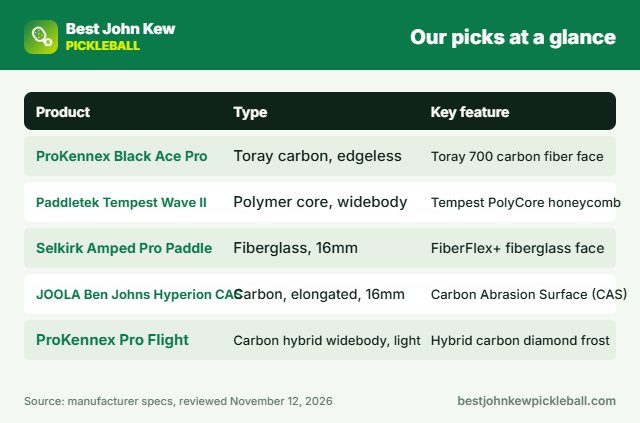
| Product | Best For | Type | Key Feature | Buy |
|---|---|---|---|---|
| ProKennex Black Ace Pro | Best Paddle for Tendonitis Overall | Toray carbon, edgeless | Toray 700 carbon fiber face | Check Price |
| Paddletek Tempest Wave II | Best Quiet Polymer Core | Polymer core, widebody | Tempest PolyCore honeycomb | Check Price |
| Selkirk Amped Pro Paddle | Best Foam Perimeter Paddle | Fiberglass, 16mm | FiberFlex+ fiberglass face | Check Price |
| JOOLA Ben Johns Hyperion CAS 16 | Best 16 mm Carbon Option | Carbon, elongated, 16mm | Carbon Abrasion Surface (CAS) | Check Price |
| ProKennex Pro Flight | Best Lightweight Widebody | Carbon hybrid widebody, light | Hybrid carbon diamond frost face | Check Price |
| Hesacore Pickleball Grip 5.25 in | Best Grip Upgrade | Replacement grip | Patented hexagonal design | Check Price |
Our 6 Top Picks in Detail
Here is a closer look at each pick on our list of the best pickleball paddle for tendonitis, with specs, pros and cons.

1. ProKennex’s edgeless Toray carbon paddle with a patented Kinetic shock-absorbing system. ProKennex says its Kinetic System cuts vibration by 43%.
👍 Pros & Cons
Pros
- ProKennex says Kinetic System cuts vibration 43%
- Edgeless for faster hands
- Arm-friendly reputation
Cons
- Small 4 in grip
- Premium price
📄 Detailed Review
- Toray 700 carbon fiber face
- Patented Kinetic System
- Edgeless design
- Air-O-Guard interchangeable edge guard
- 4 in grip
ProKennex states that the Black Ace Pro’s Kinetic technology reduces vibration by 43%. The edgeless design improves reflexes in quick exchanges.
This makes it a frequent consideration for players worried about arm comfort.

2. A popular Paddletek control paddle with a quiet polymer core and a wide 8-inch face. A quiet, consistent core with a cushioned high-tack grip.
👍 Pros & Cons
Pros
- Quiet, consistent core
- Wide face for an ample sweet spot
- Light yet stable
Cons
- Classic design
- Limited stock
📄 Detailed Review
- Tempest PolyCore honeycomb
- 7.4–7.8 oz
- 15 7/8 x 8 in face
- 1/8 in edge guard
- Ultra-cushion high-tack grip
Paddletek says the Tempest Wave II’s PolyCore gives an ample sweet spot, and the graphite in the core dampens vibration. A thin 1/8 inch edge guard protects the paddle.
At 7.4–7.8 oz it is light, with a cushioned, high-tack grip.
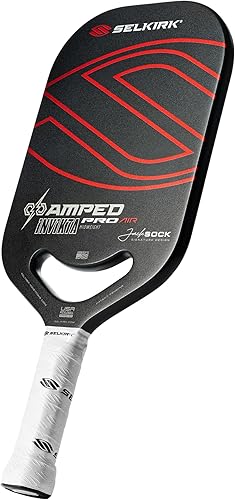
3. Selkirk’s updated Amped with a fiberglass face, 16 mm X5+ core and a foam perimeter that absorbs vibration. A 16 mm core and FlexFoam perimeter that absorbs vibration.
👍 Pros & Cons
Pros
- Fiberglass pop with a 16 mm core
- Edgeless design enlarges sweet spot
- Foam perimeter absorbs vibration
Cons
- Higher price than basic fiberglass
- Elongated Invikta shape listed by default
📄 Detailed Review
- FiberFlex+ fiberglass face
- X5+ raw honeycomb core, 16 mm
- Air Dynamic Throat
- ProSpin+ NextGen texture
- Aero-DuraEdge edgeless design with FlexFoam
The Amped Pro combines a FiberFlex+ fiberglass face with a 16 mm X5+ honeycomb core for balanced power. Selkirk adds its Air Dynamic Throat and ProSpin+ NextGen texture.
Aero-DuraEdge edgeless tech and a FlexFoam perimeter are designed to expand the sweet spot and dampen vibration, which helps players who want comfort.

4. A more affordable Ben Johns Hyperion with a sand-blasted carbon face and a 16 mm core tuned for control. A thick 16 mm core that adds control and reduces vibration.
👍 Pros & Cons
Pros
- Sand-blasted carbon for spin
- Thick 16 mm core adds control and reduces vibration
- Recognizable pro model at a lower price
Cons
- Elongated shape is less forgiving than widebody
- Spin texture wears with heavy use
📄 Detailed Review
- Carbon Abrasion Surface (CAS)
- Hybrid-Ply construction
- 16 mm Response polypropylene core
- Elongated Hyperion shape
- Sure-Grip perforated grip
The Hyperion CAS 16 uses JOOLA’s Carbon Abrasion Surface, created through a multi-step sand-blasting process for grip on the ball. Hybrid-Ply layering is designed for control and feel.
The 16 mm Response polymer core reduces vibration, and the Sure-Grip handle has a perforated anti-slip ridge. A great all-court option for improving players.

5. A light widebody ProKennex paddle with a carbon hybrid face. 7.3–7.6 oz with a forgiving wide body.
👍 Pros & Cons
Pros
- Lightweight widebody
- ProKennex comfort reputation
- Forgiving shape
Cons
- Shorter reach
- Small grip
📄 Detailed Review
- Hybrid carbon diamond frost face
- Cloud Cell poly core
- Wide body shape
- 7.3–7.6 oz
- 15.43 in long
The Pro Flight weighs 7.3–7.6 oz with a wide body shape and Cloud Cell poly core. Its hybrid carbon face uses a diamond frost finish.
A friendly paddle for players who want light weight and a forgiving face.

6. A hexagon-textured replacement grip designed to absorb vibration and reduce grip effort. A hexagonal grip that Hesacore says absorbs vibration.
👍 Pros & Cons
Pros
- Hexagon pattern for secure hold
- Absorbs vibration
- Two thicknesses
Cons
- Requires removing factory grip
- Not for handles under 5 in
📄 Detailed Review
- Patented hexagonal design
- Medium-soft material
- 5.25 in length
- S (1.5 mm) or M (2.0 mm) thickness
- Absorbs sweat and vibration
Hesacore says its hexagonal design expands contact by up to 14%. The semi-soft material absorbs sweat and vibration.
It replaces the factory grip.
How We Chose the Best Pickleball Paddle for Tendonitis
To choose the best pickleball paddle for tendonitis, we compared manufacturer specifications for vibration, core thickness, weight and grip across more than 20 products sold on Amazon, and read independent reviews and recurring buyer feedback to spot problems that spec sheets miss. We did not hands-on test every product; our Editor Scores are editorial judgments based on that research.
For rules and equipment standards we follow USA Pickleball, the sport’s US governing body. You can read the full scoring process on our Review Methodology page.
Buying Guide: How to Choose the Best Pickleball Paddle for Tendonitis
Where vibration comes from
Off-center hits and hard, thin paddles send more shock into the hand and arm. Honeycomb polymer cores, thicker cores, foam-filled or foam-wrapped edges and cushioned grips all help absorb it. Heavier paddles can also feel more stable, but they demand more from the shoulder.
Pick a core thickness on purpose
A 16 mm core, like the one in the Selkirk Amped Pro, CRBN X Series or Selkirk Valkyrie, dwells on the ball longer and gives you more control on dinks and resets. A 13 mm core, like the HEAD Radical Elite or Selkirk Halo, feels livelier and adds pop. Thinner cores (10–11 mm) are the most powerful and the least forgiving.
Check weight before anything else
Most adult paddles weigh 7.3 to 8.5 oz. Lighter paddles (around 7.5 oz) are quicker at the kitchen and easier on the arm; midweights around 8 oz add stability and plow-through. Very heavy wood paddles, like the 9.5–10.5 oz Franklin Activator, are durable but tiring over a long session.
Get the grip size right
Most adult paddles use a grip of about 4 1/4 inches around. Smaller hands may prefer 4 to 4 1/8 inches, like the JOOLA Stratos or HEAD Cyber Elite, while big hands can add an overgrip. A grip that is too small makes you squeeze, which tires the forearm.
When to change the grip instead
If your paddle already suits your game, a cushioned or vibration-absorbing grip is a cheaper first step than a new paddle.
Tips for Playing With Tendonitis
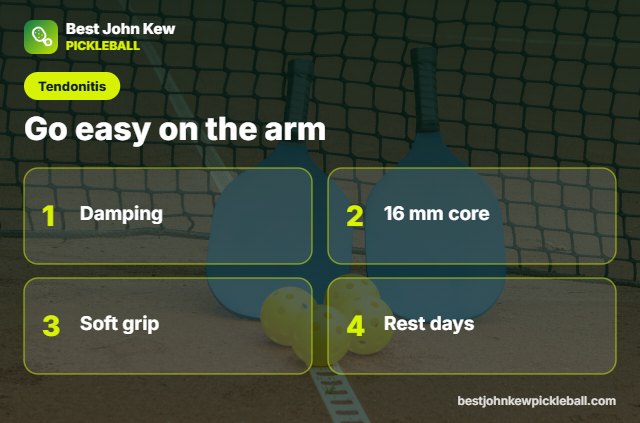
- Warm up your wrist and forearm before playing.
- Hold the paddle loosely between shots.
- Limit long sessions while symptoms settle.
- Follow your doctor or physical therapist’s plan.
Below are answers to common questions about the best pickleball paddle for tendonitis.
Frequently Asked Questions
What are the best pickleball paddle for tendonitis?
Our top choice for the best pickleball paddle for tendonitis is the ProKennex Black Ace Pro (best paddle for tendonitis overall). The Paddletek Tempest Wave II and Selkirk Amped Pro Paddle are strong alternatives, depending on how and where you play.
Can a paddle cause tendonitis?
Repeated jarring impact, a grip that is the wrong size or squeezing too hard can all add stress. A softer setup may help, but see a clinician for diagnosis.
Is a heavier or lighter paddle better for tendonitis?
A moderate weight is often a good balance. Very light paddles can transmit more vibration, while very heavy paddles add load.
Final Verdict
Our final pick for the best pickleball paddle for tendonitis: ProKennex Black Ace Pro (best paddle for tendonitis overall). If you want something different, Paddletek Tempest Wave II is our best quiet polymer core choice, and Selkirk Amped Pro Paddle is the pick for foam perimeter paddle. For players with tendonitis, the ProKennex Black Ace Pro is our top paddle pick. For a lower-cost change, start with a Hesacore grip.
Related Guides
Keep comparing with these related guides from our team:
Prices and availability change often; always check the current listing before you buy.







Write Your Review
No reviews yet. Be the first to share your experience!