

As an Amazon Associate we earn from qualifying purchases. Our picks are chosen independently; see our Affiliate Disclosure.
Foam balls cut noise and are gentle for kids and small spaces. The best foam pickleball balls picks compare foam with soft indoor balls.
Specs come from each brand’s own pages; we did not hands-on test every product and list no prices or star ratings.
Specs come from manufacturer descriptions and independent reviews we checked on November 19, 2026. Prices, sizes and availability on Amazon change often, so check the live listing before you buy.
Quick Answer: The Best Foam Pickleball Balls
- Best Overall Pick: Franklin Silent Serve Foam Pickleballs
- Best Value Foam Pack: Kikkavo Foam Pickleball Balls (6-Pack)
- Best Gym Upgrade: Franklin X-26 Indoor Pickleballs
- Best Low-Skid Indoor: Onix Fuse Indoor Pickleballs
- Best Rough-Finish Indoor: Wilson TRU 32 Pickleballs
Franklin Silent Serve is our pick for the best foam pickleball balls because it keeps the official 74 mm size with a noise-reduction design. Kikkavo’s 6-pack is the value foam pack.
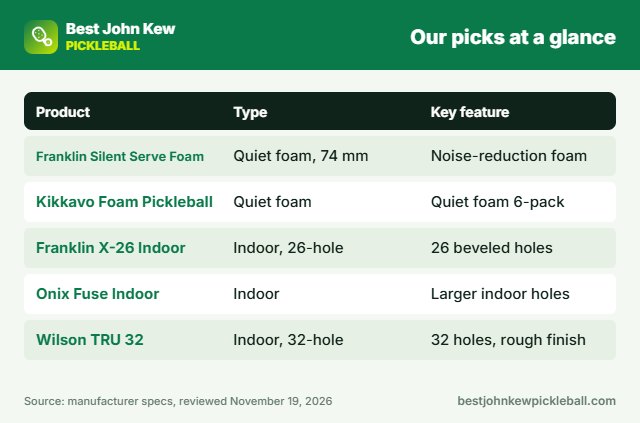
Best Foam Pickleball Balls Comparison Table
| Product | Best For | Type | Key Feature | Buy |
|---|---|---|---|---|
| Franklin Silent Serve Foam Pickleballs | Best Overall Pick | Quiet foam, 74 mm | Official 74 mm size | Check Price |
| Kikkavo Foam Pickleball Balls (6-Pack) | Best Value Foam Pack | Quiet foam | Foam construction | Check Price |
| Franklin X-26 Indoor Pickleballs | Best Gym Upgrade | Indoor, 26-hole | 26 beveled holes | Check Price |
| Onix Fuse Indoor Pickleballs | Best Low-Skid Indoor | Indoor | Larger hole pattern for indoor courts | Check Price |
| Wilson TRU 32 Pickleballs | Best Rough-Finish Indoor | Indoor, 32-hole | Patented 32-hole configuration | Check Price |
Our 5 Top Picks in Detail
Here is a closer look at each pick on our list of the best foam pickleball balls, with specs, pros and cons.

1. A quiet, 74 mm foam ball from Franklin for noise-restricted courts and at-home practice. Official 74 mm size with a noise-reduction design.
👍 Pros & Cons
Pros
- Built for HOA and noise-restricted courts
- Made to mimic the look and feel of a regular ball, per Franklin
- Soft impact for kids and first-time players
Cons
- Not a tournament ball
- Small pack size
📄 Detailed Review
- Official 74 mm size
- Noise-reduction design
- Optic yellow
- 3-pack
Franklin made the Silent Serve for players who need a quieter game, including courts with HOA or noise rules. It keeps the regulation 74 mm size so your swing timing stays familiar.
Franklin says it mimics the look and feel of a traditional pickleball, and its optic yellow color is easy to see. It is a practice and recreation ball, not a tournament ball.

2. A six-pack of quiet foam balls for indoor practice and family play. A 6-pack for indoor practice.
👍 Pros & Cons
Pros
- An inexpensive way to practice indoors
- Soft and quiet for kids
- Six balls per pack
Cons
- Small brand with limited published specs
- Foam bounces differently from a regulation ball
📄 Detailed Review
- Foam construction
- 6-pack
- Designed for indoor practice and family play
- Quieter than hard plastic balls
Kikkavo’s foam balls are sold for quiet indoor practice and family-friendly play. Foam is soft, so it is a safer choice for young kids and for hitting inside the house or garage.
Foam does not bounce like a hard pickleball, so use these for touch, hand-eye and swing practice, then move to a regulation ball for real games.
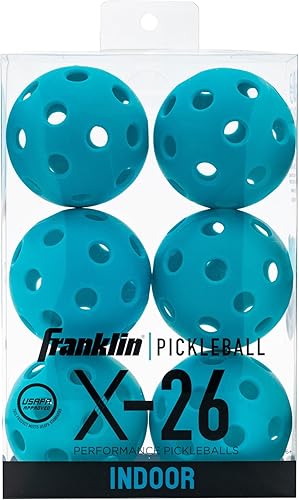
3. Franklin’s USA Pickleball approved indoor ball, built for gym floors and indoor courts. An approved 26-hole indoor ball.
👍 Pros & Cons
Pros
- Indoor hole pattern plays slower than outdoor balls
- Franklin cites even rotation, spin and bounce
- Available in a variety of colors
Cons
- Not built for rough outdoor surfaces
- Fewer pack sizes than the X-40
📄 Detailed Review
- 26 beveled holes
- Solid two-piece construction
- USA Pickleball approved for indoor tournament play, per Franklin
- Sold in 3, 12 and 100 packs
The X-26 is Franklin’s indoor ball: 26 beveled holes and a solid two-piece build. Franklin describes premium durability with even rotation, spin and bounce.
Indoor balls like this one play slower and softer than outdoor balls, which gives you a little more time on each shot. Use it on wood or sport-tile floors, not on asphalt or concrete.

4. Onix’s indoor tournament ball, with a larger hole pattern and a softer bounce for gym floors. Onix’s Fuse Indoor.
👍 Pros & Cons
Pros
- Onix says it has less bounce and reduced skid indoors
- Ready to play out of the box
- Two high-contrast colors
Cons
- Not meant for outdoor courts
- Seamed construction
📄 Detailed Review
- Larger hole pattern for indoor courts
- Seam welding to resist splitting, per Onix
- Meets USA Pickleball requirements for indoor tournaments, per Onix
- Orange or yellow
Onix describes the Fuse as an indoor ball with a larger hole pattern, less bounce off indoor courts and reduced skid. Seam welding is meant to improve durability and resist splitting.
Onix states it meets USA Pickleball requirements for indoor tournament play. Choose orange on light floors and yellow on darker ones for the best contrast.

5. Wilson’s fast indoor ball with a patented 32-hole layout and a rough finish. Wilson’s TRU 32.
👍 Pros & Cons
Pros
- Wilson says it plays fast with consistent flight
- Rough finish on the shell
- Bright colors that stand out indoors
Cons
- Designed for indoor play
- Sold in small packs
📄 Detailed Review
- Patented 32-hole configuration
- Rough finish
- USAPA approved for competitive play, per Wilson
- Orange and yellow versions
Wilson designed the TRU 32 for indoor pickleball, with a patented 32-hole configuration and a rough finish. Wilson says it plays fast and has its most consistent flight to date.
Wilson sells it in a highly visible orange, and Amazon also lists a yellow version. It is approved by USA Pickleball for competitive play, according to Wilson.
How We Chose the Best Foam Pickleball Balls
To choose the best foam pickleball balls, we compared manufacturer specifications for noise, size, packs and color across more than 20 products sold on Amazon, and read independent reviews and recurring buyer feedback to spot problems that spec sheets miss. We did not hands-on test every product; our Editor Scores are editorial judgments based on that research.
For rules and equipment standards we follow USA Pickleball, the sport’s US governing body. You can read the full scoring process on our Review Methodology page.
Buying Guide: How to Choose the Best Foam Pickleball Balls
Pick a color you can see
Yellow balls are easiest to track against most green and blue courts, while orange can stand out better on light indoor floors or in low sun. Choose the color with the most contrast against your court and background.
Buy in the right pack size
Small packs are good for testing a ball. Once you know what you like, 12-, 36-, 60- or 100-ball packs cut the cost per ball, which matters because outdoor balls do not last forever.
Indoor vs outdoor hole patterns
Outdoor balls, such as the Franklin X-40, have about 40 smaller holes and harder shells so they fly true in wind and survive rough courts. Indoor balls, such as the Franklin X-26 or Onix Fuse, have fewer, larger holes and play softer and slower. Using the wrong type makes the game harder.
Expect balls to wear out
Every hard plastic ball eventually cracks, goes soft or loses its round shape. Cold weather and rough courts speed that up. Seamless shells and crack-resistant designs help, and Selkirk backs the Pro S1 with a one-year no-crack warranty.
Check approval if you compete
Sanctioned events use balls that meet USA Pickleball standards. Makers such as Franklin, Selkirk, Gamma and JOOLA say their tournament balls are approved, while Onix lists the Pure 2 as a recreational ball that does not meet tournament requirements.
Tips for Playing With Foam Pickleball Balls
- Foam is slower.
- Use for warm-ups.
- Great for kids.
- Switch to plastic for matches.
Below are answers to common questions about the best foam pickleball balls.
Frequently Asked Questions
What are the best foam pickleball balls?
Our top choice for the best foam pickleball balls is the Franklin Silent Serve Foam Pickleballs (best overall pick). The Kikkavo Foam Pickleball Balls (6-Pack) and Franklin X-26 Indoor Pickleballs are strong alternatives, depending on how and where you play.
Are foam pickleball balls quieter?
Yes, foam balls are much quieter than hard plastic balls.
Can foam balls be used in tournaments?
No, tournaments use approved plastic balls.
Final Verdict
Our final pick for the best foam pickleball balls: Franklin Silent Serve Foam Pickleballs (best overall pick). If you want something different, Kikkavo Foam Pickleball Balls (6-Pack) is our best value foam pack choice, and Franklin X-26 Indoor Pickleballs is the pick for gym upgrade. For most quiet practice, Franklin Silent Serve is our top choice. For a value pack, choose Kikkavo foam balls.
Related Guides
Keep comparing with these related guides from our team:
Prices and availability change often; always check the current listing before you buy.

Write Your Review
No reviews yet. Be the first to share your experience!