

As an Amazon Associate we earn from qualifying purchases. Our picks are chosen independently; see our Affiliate Disclosure.
A lighter paddle can be easier to lift and hold for long sessions with arthritis. The best lightweight pickleball paddle for arthritis picks below weigh about 6.9–8.0 oz and favor wide faces and quiet cores.
Very light paddles can need harder swings, so we balanced weight with stability.
This guide is general information, not medical advice. If you have pain or a diagnosed condition, talk to a doctor or physical therapist before changing equipment or returning to play.
Specs come from manufacturer descriptions and independent reviews we checked on November 14, 2026. Prices, sizes and availability on Amazon change often, so check the live listing before you buy.
Quick Answer: The Best Lightweight Pickleball Paddle for Arthritis
- Best Lightweight Paddle for Arthritis Overall: Paddletek Tempest Wave II
- Best Very Light Oversized: Onix Graphite Stryker Oversized
- Best Light Carbon Widebody: ProKennex Pro Flight
- Best Light Graphite: Selkirk SLK Latitude 2.0 Paddle
- Best Light Polymer: Paddletek Bantam TS-5
- Best Light Long Handle: JOOLA Essentials Dash 7.8 oz
The Paddletek Tempest Wave II is our pick for the best lightweight pickleball paddle for arthritis because its 7.4–7.8 oz weight, quiet core and wide face are easy on sore hands. The Onix Stryker is the lightest, and the ProKennex Pro Flight is the light carbon option.
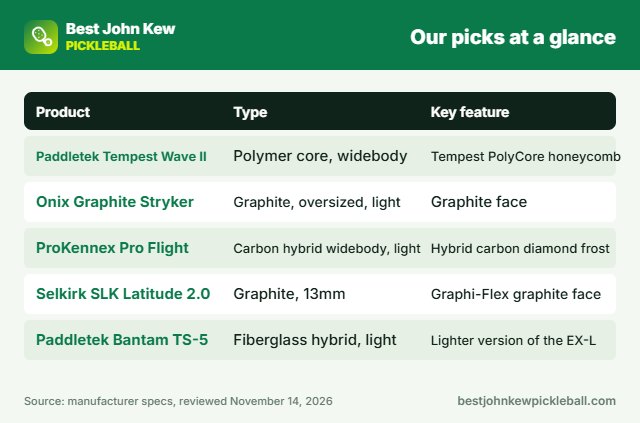
Best Lightweight Pickleball Paddle for Arthritis Comparison Table
| Product | Best For | Type | Key Feature | Buy |
|---|---|---|---|---|
| Paddletek Tempest Wave II | Best Lightweight Paddle for Arthritis Overall | Polymer core, widebody | Tempest PolyCore honeycomb | Check Price |
| Onix Graphite Stryker Oversized | Best Very Light Oversized | Graphite, oversized, light | Graphite face | Check Price |
| ProKennex Pro Flight | Best Light Carbon Widebody | Carbon hybrid widebody, light | Hybrid carbon diamond frost face | Check Price |
| Selkirk SLK Latitude 2.0 Paddle | Best Light Graphite | Graphite, 13mm | Graphi-Flex graphite face | Check Price |
| Paddletek Bantam TS-5 | Best Light Polymer | Fiberglass hybrid, light | Lighter version of the EX-L | Check Price |
| JOOLA Essentials Dash 7.8 oz | Best Light Long Handle | Sandblasted fiberglass, light | Sandblasted fiberglass face | Check Price |
Our 6 Top Picks in Detail
Here is a closer look at each pick on our list of the best lightweight pickleball paddle for arthritis, with specs, pros and cons.

1. Paddletek Tempest Wave II
9.6/10iCheck Price on Amazon.com ↗
1. A popular Paddletek control paddle with a quiet polymer core and a wide 8-inch face. A quiet polymer core and 8 in face at 7.4–7.8 oz.
👍 Pros & Cons
Pros
- Quiet, consistent core
- Wide face for an ample sweet spot
- Light yet stable
Cons
- Classic design
- Limited stock
📄 Detailed Review
- Tempest PolyCore honeycomb
- 7.4–7.8 oz
- 15 7/8 x 8 in face
- 1/8 in edge guard
- Ultra-cushion high-tack grip
Paddletek says the Tempest Wave II’s PolyCore gives an ample sweet spot, and the graphite in the core dampens vibration. A thin 1/8 inch edge guard protects the paddle.
At 7.4–7.8 oz it is light, with a cushioned, high-tack grip.

2. A very light oversized Onix graphite paddle that makes contact easier for beginners and older players. A 6.9–7.4 oz oversized graphite face.
👍 Pros & Cons
Pros
- Very light at 6.9–7.4 oz
- Oversized shape for a larger sweet spot
- Great for slower swings
Cons
- Light paddles give less plow-through
- Basic graphite spin
📄 Detailed Review
- Graphite face
- Polypropylene core
- Oversized shape: 15.5 x 7.8 in
- 6.9–7.4 oz lightweight
- For all levels
The Stryker uses an oversized shape for a larger hitting surface and a graphite face for touch and power. Onix lists it at a light 6.9–7.4 oz.
That light weight makes it easy on shoulders and wrists.

3. A light widebody ProKennex paddle with a carbon hybrid face. A 7.3–7.6 oz carbon hybrid widebody.
👍 Pros & Cons
Pros
- Lightweight widebody
- ProKennex comfort reputation
- Forgiving shape
Cons
- Shorter reach
- Small grip
📄 Detailed Review
- Hybrid carbon diamond frost face
- Cloud Cell poly core
- Wide body shape
- 7.3–7.6 oz
- 15.43 in long
The Pro Flight weighs 7.3–7.6 oz with a wide body shape and Cloud Cell poly core. Its hybrid carbon face uses a diamond frost finish.
A friendly paddle for players who want light weight and a forgiving face.
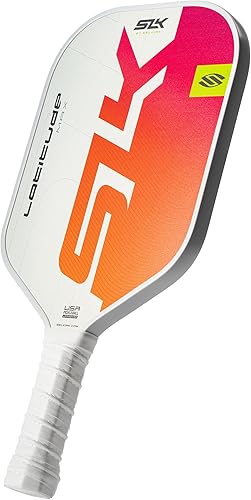
4. A lightweight SLK graphite paddle with a 13 mm core, made for developing players who want control and spin. A 13 mm graphite paddle at 7.6–8.0 oz.
👍 Pros & Cons
Pros
- Lightweight and easy to maneuver
- Built for developing players
- Comfortable contoured grip
Cons
- 13 mm core is less plush than 16 mm
- Graphite spin is moderate
📄 Detailed Review
- Graphi-Flex graphite face
- SX4 13 mm polymer honeycomb core
- 7.6–8.0 oz
- SpinFlex+ texture
- SLK Comfort Contour grip
The Latitude 2.0 combines a Graphi-Flex graphite face with SpinFlex+ texture and a 13 mm SX4 polymer core. Selkirk lists a 7.6–8.0 oz weight range.
It is a comfortable, maneuverable choice for players who want a light paddle without going to a kids’ size.

5. A lighter version of Paddletek’s Bantam EX-L for players who want faster hands. A lighter Bantam with a quiet PolyCore.
👍 Pros & Cons
Pros
- Lighter than the EX-L for quick hands
- Quiet core
- Responsive returns
Cons
- Light weight gives less plow-through
- Limited stock
📄 Detailed Review
- Lighter version of the EX-L
- Bantam PolyCore honeycomb
- Textured fiberglass epoxy hybrid face
- 4 1/4 in grip
- Standard shape
Paddletek calls the TS-5 a lighter version of its popular EX-L, combining reduced weight with the Bantam PolyCore for quick, responsive returns.
It suits players who value hand speed at the kitchen line.

6. A light, beginner-friendly JOOLA paddle with a sandblasted fiberglass face and a long handle. A 7.8 oz fiberglass paddle with a 5.5 in handle.
👍 Pros & Cons
Pros
- Light and easy to swing
- Gritty face helps beginners find spin
- Long handle for extended reach
Cons
- Entry-level performance ceiling
- Not built for heavy hitters
📄 Detailed Review
- Sandblasted fiberglass face
- About 7.8 oz lightweight
- Signature shape with 5.5 in handle
- Cool Press construction
- NFC chip and 12-month warranty
JOOLA designed the Essentials Dash “with beginners in mind,” promising an easy learning curve and forgiving feel. The sandblasted fiberglass face adds grit for spin.
Its lightweight build makes it easy to swing for players of all ages, including seniors and teens.
How We Chose the Best Lightweight Pickleball Paddle for Arthritis
To choose the best lightweight pickleball paddle for arthritis, we compared manufacturer specifications for weight, core softness, face size and grip across more than 20 products sold on Amazon, and read independent reviews and recurring buyer feedback to spot problems that spec sheets miss. We did not hands-on test every product; our Editor Scores are editorial judgments based on that research.
For rules and equipment standards we follow USA Pickleball, the sport’s US governing body. You can read the full scoring process on our Review Methodology page.
Buying Guide: How to Choose the Best Lightweight Pickleball Paddle for Arthritis
Check weight before anything else
Most adult paddles weigh 7.3 to 8.5 oz. Lighter paddles (around 7.5 oz) are quicker at the kitchen and easier on the arm; midweights around 8 oz add stability and plow-through. Very heavy wood paddles, like the 9.5–10.5 oz Franklin Activator, are durable but tiring over a long session.
Where vibration comes from
Off-center hits and hard, thin paddles send more shock into the hand and arm. Honeycomb polymer cores, thicker cores, foam-filled or foam-wrapped edges and cushioned grips all help absorb it. Heavier paddles can also feel more stable, but they demand more from the shoulder.
Get the grip size right
Most adult paddles use a grip of about 4 1/4 inches around. Smaller hands may prefer 4 to 4 1/8 inches, like the JOOLA Stratos or HEAD Cyber Elite, while big hands can add an overgrip. A grip that is too small makes you squeeze, which tires the forearm.
Choose a shape you can control
Standard and widebody shapes give the biggest sweet spot and are the most forgiving. Elongated shapes, such as the HEAD Radical XL at 17 inches, add reach and leverage for power but shrink the sweet spot. If you are unsure, start with a standard or widebody paddle.
Pick a core thickness on purpose
A 16 mm core, like the one in the Selkirk Amped Pro, CRBN X Series or Selkirk Valkyrie, dwells on the ball longer and gives you more control on dinks and resets. A 13 mm core, like the HEAD Radical Elite or Selkirk Halo, feels livelier and adds pop. Thinner cores (10–11 mm) are the most powerful and the least forgiving.
Tips for Light Paddles With Arthritis
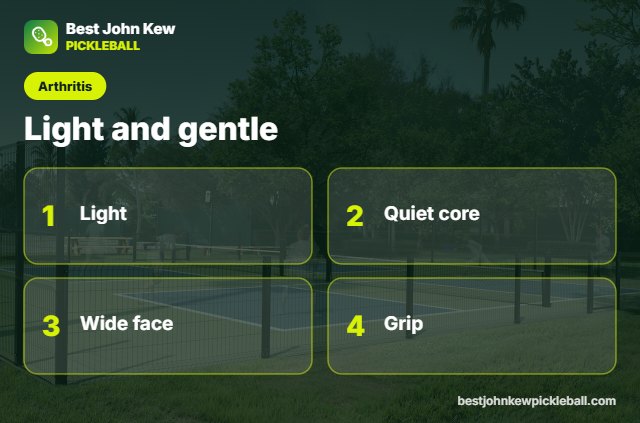
- Do not go so light that you swing harder.
- Use a cushioned grip.
- Choose a wide face for fewer mishits.
- Rest between sessions.
Below are answers to common questions about the best lightweight pickleball paddle for arthritis.
Frequently Asked Questions
What are the best lightweight pickleball paddle for arthritis?
Our top choice for the best lightweight pickleball paddle for arthritis is the Paddletek Tempest Wave II (best lightweight paddle for arthritis overall). The Onix Graphite Stryker Oversized and ProKennex Pro Flight are strong alternatives, depending on how and where you play.
Is a lightweight paddle better for arthritis?
Often, because it is easier to lift and hold, but very light paddles can need harder swings.
What weight is best for arthritic hands?
Many players with arthritis like about 7.3–7.8 oz with a cushioned grip.
Final Verdict
Our final pick for the best lightweight pickleball paddle for arthritis: Paddletek Tempest Wave II (best lightweight paddle for arthritis overall). If you want something different, Onix Graphite Stryker Oversized is our best very light oversized choice, and ProKennex Pro Flight is the pick for light carbon widebody. For most players with arthritis, the Paddletek Tempest Wave II is our top lightweight pick. For the lightest option, choose the Onix Stryker.
Related Guides
Keep comparing with these related guides from our team:
Prices and availability change often; always check the current listing before you buy.








Write Your Review
No reviews yet. Be the first to share your experience!